

Metal Products Industry

Metal Products Industry
Industry characteristics

1.The product has an extremely wide range of applications: covering industries such as building hardware, tools, structural components, containers, tableware, etc., as well as the consumer sector. It is a fundamental supporting industry of the national economy. 


2. High proportion of raw material costs: Extremely sensitive to price fluctuations of raw materials such as steel and non-ferrous metals. Cost control is crucial. 


3. A combination of technology-intensive and labor-intensive approaches: There are both highly automated precision manufacturing processes and labor-intensive assembly and processing stages. 


4. Low industry concentration, intense competition: There are a large number of enterprises, and the products are highly homogeneous. The competition is mainly based on price. 


5. Strong cyclical nature: Its development is highly correlated with the prosperity of downstream industries such as fixed asset investment, real estate, and automobile manufacturing, and is significantly influenced by the macroeconomy. 


6. High environmental and safety requirements: The energy consumption, emissions, and occupational health and safety issues during the production process have received much attention, and environmental policies are an important influencing factor.


Digital transformation goals
Level 1 (Initial Level)

Assessment levels for the digitalization level of small and medium-sized enterprises:

Digitalization foundation, management and effectiveness ≥ 20 points;

Digitalization business application scenarios should be no less than 6 scenarios (among which no less than 3 should be restrictive scenarios) The level must reach level one

Level 2 (Standard Level)

Assessment levels for the digitalization level of small and medium-sized enterprises:

Digitalization foundation, management and effectiveness ≥ 40 points;

Digitalization business application scenarios should be no less than 6 scenarios (among which no less than 3 are restrictive scenarios) and the level must reach level 2.

Level 3 (Integration Level)

Assessment levels for the digitalization level of small and medium-sized enterprises:

Digitalization foundation, management and effectiveness ≥ 60 points;

Digitalization business application scenarios should be no less than 8 scenarios (among which no less than 5 are restrictive scenarios) The level must reach level three

Level 4 (Collaborative Level)

Assessment levels for the digitalization level of small and medium-sized enterprises:

Digitalization foundation, management and effectiveness ≥ 80 points;

Digitalization business application scenarios should be no less than 10 scenarios (among which there should be no less than several restrictive scenarios) The level must reach level four

Solution

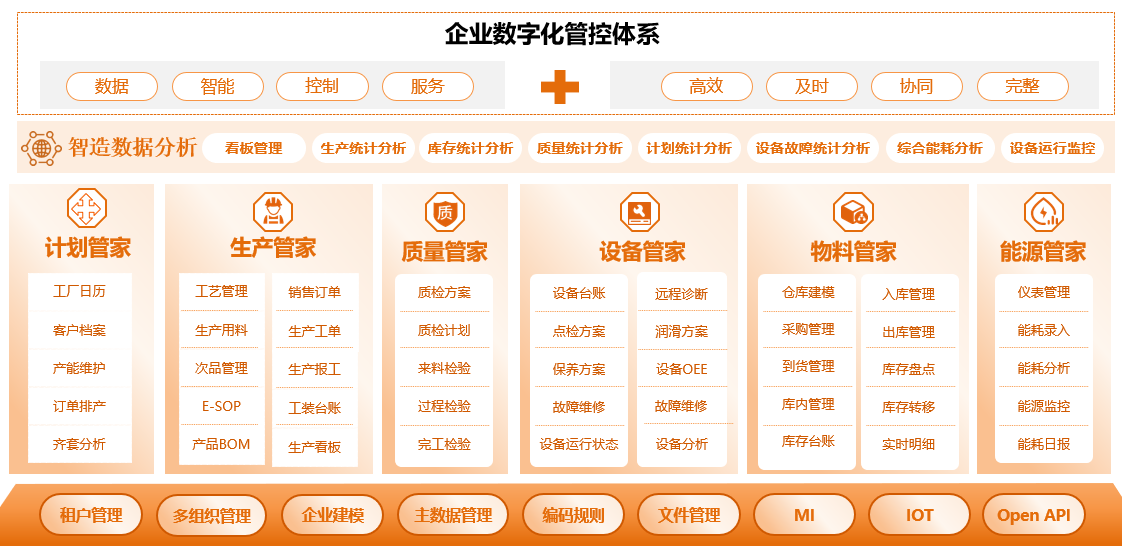
With the "Small, Fast, Lightweight and Precise" management series, we provide small and medium-sized manufacturing enterprises with lightweight, simple, efficient and precisely adapted production operation management solutions.

image.png


Typical case
Qingdao Dayuan Chengye Moulding Company
Qingdao Lianshan Casting
Qingdao Ruquan Precision Casting
Qingdao Taida Electronics